Home / Polisisation
Drop Your Number here
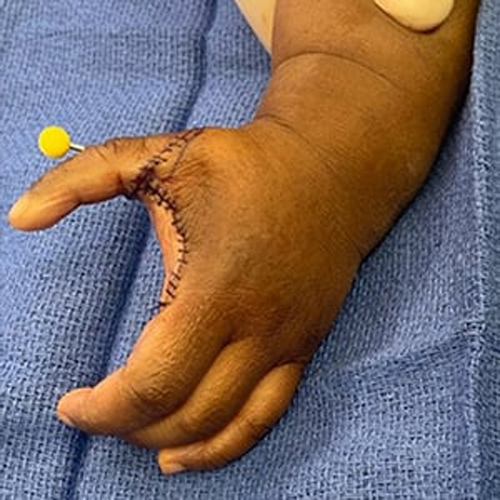
Pollicization is a highly specialized reconstructive procedure in which an existing finger (usually the index finger) is surgically repositioned and reshaped to function as a thumb. It is typically performed for patients born without a thumb (thumb aplasia) or those who have lost the thumb due to trauma or congenital deformities.
A functioning thumb is essential for fine motor skills, grasp, pinch, and overall hand function. Pollicization helps patients regain a significant level of hand utility, dexterity, and independence.
Children born with congenital absence or underdevelopment of the thumb
Patients with thumb amputation due to trauma
Conditions like Radial Club Hand or Hypoplastic Thumb
Failed thumb reconstruction surgeries
Pollicization is most effective when done early in childhood, but can also be adapted for older patients depending on hand anatomy.
The surgery involves multiple steps:
Dissecting and mobilizing the index finger
Rotating it into the thumb position
Reconstructing the joint and tendons for thumb-like motion
Repositioning nerves and blood vessels to maintain function
Cosmetic reshaping to resemble a natural thumb
The result is a digit that allows for opposition, grasp, and precision, significantly improving hand function.
Offers functional thumb replacement without prosthetics
Improves the ability to hold, grip, and manipulate objects
Enhances overall hand strength and coordination
Permanent, natural, and growing solution for children
Restores independence in daily tasks
Initial splinting for 3–4 weeks
Early mobilization and hand therapy begin thereafter
Full functional adaptation over 3–6 months
Regular physiotherapy is key for optimal outcome
Our surgical team has extensive experience in microsurgical pediatric hand reconstruction, ensuring:
Precise functional positioning
Preservation of nerve and blood supply
Excellent cosmetic results
Long-term follow-up and therapy support